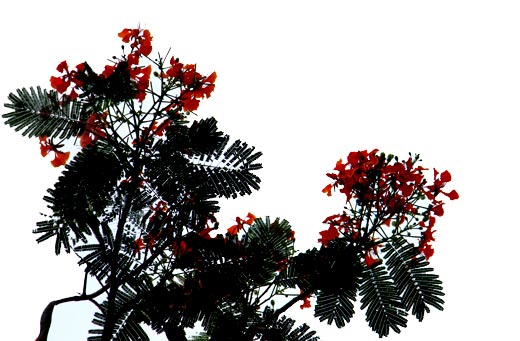
Flowers grow out of dark moments.
Corita Kent
Gone are the heat spells.
Cool winds now cooleth the soul.
It is gulmohar galore.
Everywhere.
Nothing is more uplifting than the sight of a scarlet colored flowers midst grey weather. It brings in the cheer at the fag end of summer. When the skies start to grey, the winds begin to cool and climate remains sultry, the gulmohar petals unfold brightly on the trees and fall bravely on the ground.
Gulmohar flowers announce the monsoon in wait. Its colors are a harbinger of good times to come. A respite from heat, a relief from drought, its bright colors symbolize life and the vibrancy it promises. Akin to bright vermillon and its sacred purpose, gulmohar has a reason of its own to live and thrive.
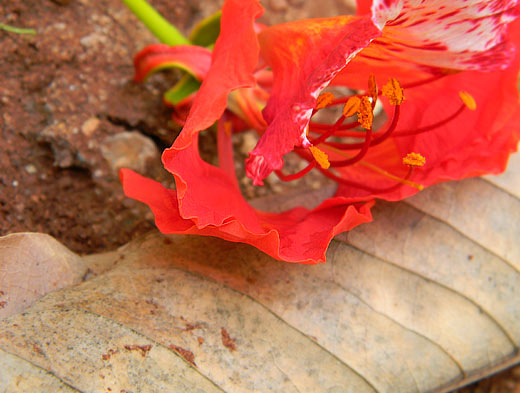
One of most beautiful sights and smells of this season is the gentle drizzle of rain, dampened earth and the wet petals of Gulmohar flowers strewn on the asphalt road. Midst the gray weather and grey asphalt lie hundreds of scarlet lives. They not only seem alive but brings everything around to life.
Where flowers bloom so does hope.
Lady Bird Johnson
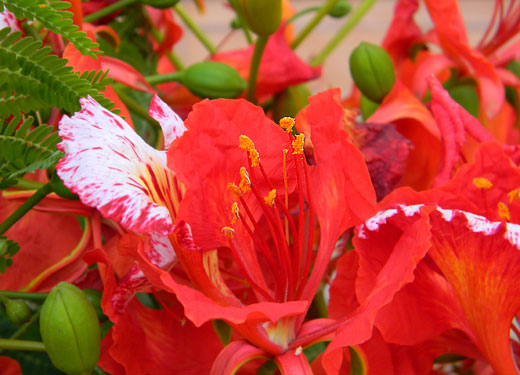
Gulmohar laden tree with scarlet bright flowers is quite a site to behold. This gentle tree with frail leaves is a common site in India. Used on pavements, roadside and gardens, this tree lives where people do. Adopted from another continent hundreds of years ago, Delonix regia aka Gulmohar has deep-rooted itself in the Indian soil and the Eastern psyche.
Gulmohar brings back a sea-tide of memories for almost everyone. Childhood spent hiding behind its tree trunks and climbing some of its stronger branches, plucking the red flowers, dismantling the flower buds to make spooky nail extensions, anthers in lock-fighting, to simply having the flowers in hands… the memories are endless.
There are always flowers for those who want to see them.
Henri Matisse
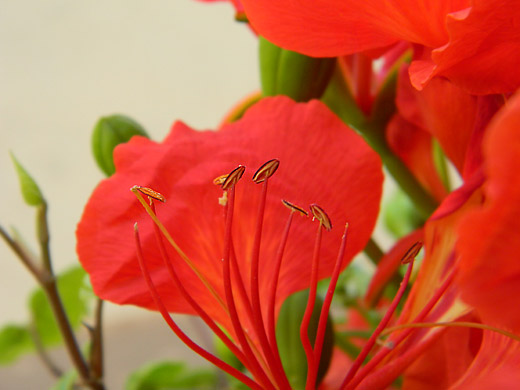
Whilst Gulmohar is a beauty to behold, its name origin is quite unflattering. ‘Delonix’ is derived from two Greek words: ‘delos’ meaning evident’ and ‘onux’ a claw in allusion to the shape of the petals. But to see a flower as a whole is an experience by itself. Tender, feathery petals of Delonix regia burst with colors of fire. From the base of the petal to the edge, there are many shades of scarlet unparalleled in nature.
High on trees, low on bush, and even when they wither and fall, Gulmohar flowers bring in color burst wherever they are. Opening your window in the morning to the sight of bright Gulmohar flowers and green leaves is a moment of a lifetime. For some reason, it gives a lot of hope and cheerfulness. Guess its color therapy at work.
A morning-glory at my window satisfies me more than the metaphysics of books.
Walt Whitman
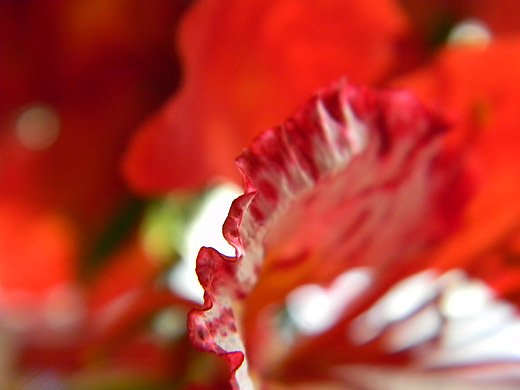
It is at the edge of a petal that love waits.
William Carlos Williams
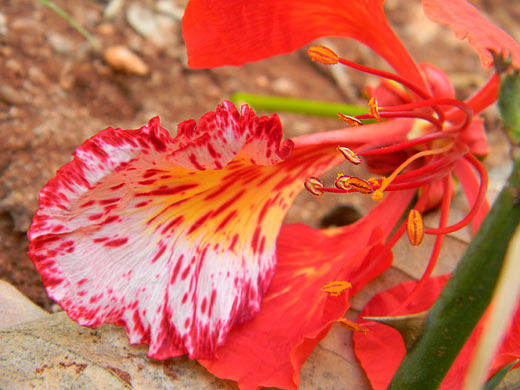
Ever wondered why one of the Gulmohar’s petal is streaked in different colors and looks different from the rest?
Botanically, it is called the upright standard petal. I’d say it is because of love.
When you live with someone long enough, you end up being like them. Same is the destiny of this petal that lives so lovingly close to the flowers inner most self. The stamens impart is characteristic colors to this petal which hugged them since birth.
These bright streaks of madness, purity and serenity are for all to see. And for those who lived with so much love in life, it just shows.
I perhaps owe having become a painter to flowers.
Claude Monet
Bread feeds the body, indeed, but flowers feed also the soul.
The Koran
This flamboyant flame tree continually inspireds the poets, artists and everyone in love with any form of art. Poems’ celebrating its flaming glory to painters reliving the scarlet moments in vivid strokes, this flaming flower holds and beholds many untold stories.
We can only discover the hidden secrets of nature in time with patience and love… only to discover that every little thing is a part of the bigger grand plan. Not just the artists and gardeners, the friends of the earth, medical fraternity and the environmentalists are waking up to see the benefits of this flower.
There are reasons for the flowers to bloom in their seasons.
A lot has been written about the medicinal uses of gulmohar in many ancient texts of Ayurveda and Siddha. But to see its real medicinal use in day-to-day lives, one must observe the remote rural India where this tree is indispensible for both humans and animals. A herbal remedy for rheumatism, flatulence, anti-inflammation, to psychosomatic medicinal uses, its uses are plenty. Indeed, it a piece of good-looking medicine.
Gulmohar Flowers for Eco-friendly Colors and Fashion
Gulmohar’s reds are the colors to die for. Highly individualistic, its flaming hues continue to inspired photographers, artists and fashion designers. For the eco-friend bandwagon, there are attempts to extract natural dye from these flowers. It is believed that the stamens of Delonix regia have a potent pigment that imparts colors to some vegetables and fruits such as bell peppers, saffron, corn, etc. Scientists in India have succeeded in their attempts to extract natural dyes from different parts of gulmohar flower by combining them with other organic substances such as turmeric and alum. It is only a matter of time that the reds of our clothes would be powered by the gulmohars.
Gulmohar for Going Green
Gulmohar is a low-maintenance tree and an ideal choice for lining the roads, avenues, gardens and parks. Because of its use for ornamental purpose, Gulmohar contributes in environmentalist’s efforts related to soil conservation, reforestation of difficult sites, soil improvement, and in protecting the footings of rivers and channel banks.
All the flowers of all the tomorrows are in the seeds of today.
Indian Proverb
If you are wanting to plant a new tree in your garden, backyard or line the avenue – think of Gulmohar tree. Take care of the sapling, and as it grows it needs less/no maintainece.
When it blooms, you will find that earth, indeed, laughs in flowers.






 HEALTH OPINE - For issues related to Indian Healthcare System


it was really help me to know about Gulmohar.
fantastic, touched my heart
Hello there Wandering Mist ,
you have a beautiful place here with such beautiful pics and an apt and awesome name .. 🙂
I am Kokila from ‘Sunshine n Blue Clouds’ and with deep thanks, I have used one of you image down here –
and have duly linked it back to you 🙂
http://sunshineandblueclouds.blogspot.in/2015/02/poem.html
In case you have any issue , do drop a message , I’ll remove it .
Till then Thanks for these small wonders of wanderings and wishing you many more such joys 🙂
Kokila.
Greetings
Wonderful blog post and amazing pictures–Thank you.
I am a retd Mariner and love the Nature, trees and flowers-(have a Nature blog also). We had many in our school compound in 1950s in Madras and as children Nature Study classes was in our schedule -We grew to love them. When we rejoined school after summer holidays and saw them all across–Flame red ..or fallen like a red carpet all over it was a delight–
The poet Sarojini Naidu has composed a poem on this , which I saw and is quoted here-Sarojini Naidu (1879-1949) also called Nightingale of India–Rgds & Best wishes
Capt.TR
‘In Praise of Gulmohar Blossoms’ by Sarojini Naidu
What can rival your lovely hue
O gorgeous born of the spring?
The glimmering bridal of a red robe
Rich red of a wild bird’s wing
Or the mystic blade of the gem that burns
On the brow of a serpent king
What can rival the valiant joy
Of your dazzling fugitive sheen
The limpid clouds of the lustrous dawn
That colours the Ocean’s mien?
Or the blood that poured from a thousand breasts
To succour a Rajput queen
Thank you for leaving your thoughts here and the lovely poem too. Im happy that you had and are having your share of Gulmohar. Are’nt they a sight to behold?
I did not know of this poem and you have left this message at an opportune time for me…. when I needed some words. Thank you ever so much for this. Please drop by again and we could share more notes on nature.
I always loved Gulmohar flowers. Can you tell me what they call the middle part. The long thin veins with heady edges?
Latha: Those are called STAMENS. Stamens consist of two parts: a stalk called a filament, topped by an anther where ‘heady edges’ pollen (yellowish/ powdery) is produced and dispersed.
Hope this helps. Thanks for wandering by.
keep usess olso
Thanks James. That wass quite a food for thought. True that it was native to Madagascar.
What nonsense about much being written in Vedic texts about Gulmohar’s medicinal uses!! Delonix regia or gulmohar is an introduced species, native to Madagascar, where it is endemic in the wild!!!! Check your sources!
ha ha we did make those ghost like nails and ate the white petals (only the white petals!!)..did you ? hey,believe me it is edible..see i am alive!!!
JustAroundMe: I dont remember eating any flower… except for Cauliflower… LOL.
Those nails… oh my… looks like almost every one did it. Im glad to know this about you now.
I’ve recently started a blog, the information you provide on this site has helped me tremendously. Thank you for all of your time & work.
Sounds magical….may it come true one day….one can hope, pray, and try…
Love,
Mystic Peace Poet
Mystic: Not to mention that one person argued that having a town filled with Gulmohars would mean more garbage on streets as the leaves fall all the time. LOL.
Heights of ingenuity!!!
Beautiful post 🙂 My childhood home was on a street lined with giant gulmohar trees… I remember the days we went picking up these red flowers, using gulmohar buds to make “ghost” nails,… These trees are so much fun and beauty.
Lovely Photographs. Your description and quotes are equally beautiful. Earth indeed laughs in flowers!
Iniyaal: Wow! That must have been great to live amongst Gulmohar trees. Did you also make those spooky nail stuff… LOL. I always thought that was gross, even when I saw my cousins do that. LOL. But kudos to child’s imagination… it really goes places.
Mystic: I once read that some part of Pakistan wanted to fill one town with Gulmohar…. wonder if that is true. How beautiful that would be.
Beautiful post my dear….as always…writing and presentation at it’s best!
Your heart is a rose…
Always, Mystic.
I am writing to you from Nalandaway Foundation,an NGO for child rights based in Chennai. I went through your blog and found it very interesting and delightful to read.
Every year we conduct an Annual children’s festival in Chennai called “Art Arattai Aarpattam”which includes professional shows, an arts carnival and a film festival.
We would like to know if you would be interested in covering the festival in your blog.
We would really appreciate your response to this message.We would like to mail you our brochure and details regarding the festival
if interested please send me your ID at upasana@nalandaway.org
looking forward to hearing from you
Regards,
Upasana: Let me know of the dates for coverage. I will see if I am in Chennai at that time. Would love to do it. Cheers!